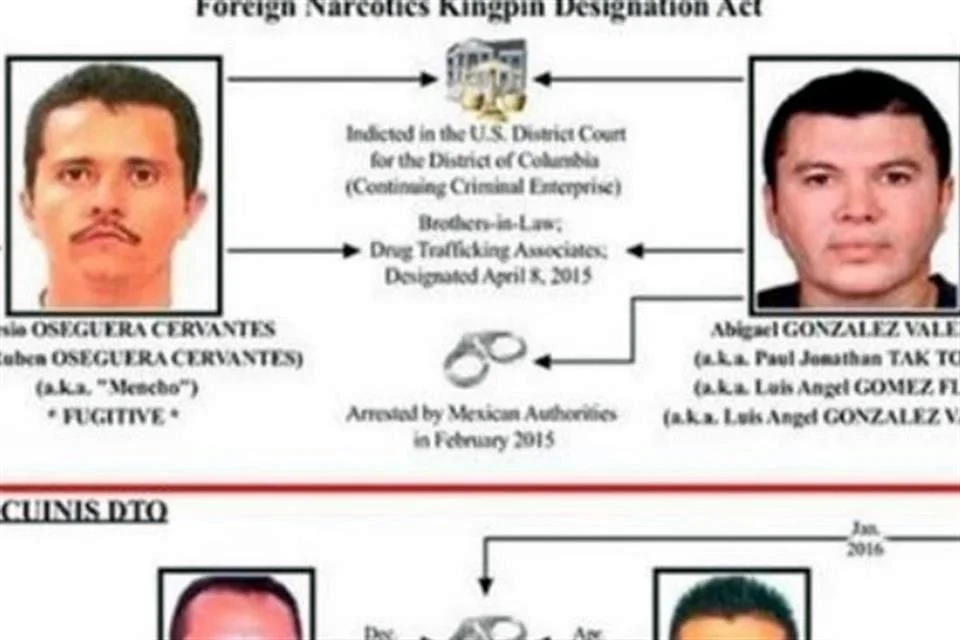
In Argentina, González Valencia's landing is said to have relied on locally registered societies, front men, and operators who, according to judicial files and journalistic reports, facilitated the flow of funds into the formal circuit. Over time, the investigation pointed to the firm Círculo Internacional S.A., linked to Círculo México, as part of the corporate scaffolding that would have received funds from abroad. Journalistic reports indicated that he was arrested by Interpol in Punta del Este within the framework of an Argentine request, and that his role would have included tasks of administration, auditing, and representation of corporate interests that went beyond the usual commercial functioning. The case is not an isolated incident, and that is the point that should concern—and occupy—authorities. For U.S. agencies, Los Cuinis were not a minor appendage: they were a decisive gear to move, transform, and 'launder' narco money in multiple jurisdictions. The Argentine chapter had, in addition, concrete signals that emerged before the case escalated, as reported by La Nación. The warning is known in courts and agencies: when real estate becomes a 'safe' for crime, the risk is not only economic, but institutional, because narco investment brings influence, networks, contracting of services, and a silent capture of spaces. That is why, the trail of the CJNG's financial environment in Puerto Madero serves as an uncomfortable reminder: Argentina is not an island and the 'landing' can occur in broad daylight, behind a neat business, an anonymous society, and a transfer circuit that, with real control and coordination, should be detectable. In Argentina, there are precedents of investigations into trusts and real estate structures in Nordelta and other cantons of the Tigre party under suspicion of money laundering maneuvers and unjustified funds. At the end of 2022, he admitted his participation in a conspiracy to import and distribute cocaine to the U.S. market, although investigators maintained that the real scope was greater. To focus on time—on the traceability of money, on the ultimate beneficiaries, on real estate projects that grow at an inexplicable speed—is not a slogan: it is a prevention policy. Over time, however, that enterprise became associated with a name that today summarizes the financial side of transnational organized crime: Gerardo González Valencia, brother-in-law of Nemesio Oseguera Cervantes ('El Mencho') and a figure pointed out as number two of Los Cuinis, the economic arm of the Jalisco New Generation Cartel (CJNG). The reconstruction of the case exposes a pattern that worries researchers and specialists: the ability of narco-criminal organizations to 'camouflage' capital in dynamic markets, with real estate and front businesses as entry doors. Regional experience shows that narco money persistently seeks assets that 'absorb' capital: real estate developments, trusts, gated communities, tourism ventures, high-end cars. According to reports attributed to the Financial Information Unit (UIF) in the framework of the case, between 2009 and 2011 the local society received about US$1.8 million from its Mexican shareholder, funds whose origin was put under suspicion due to their alleged links to the criminal network. In this line, the judicial investigation in Argentina—with the intervention of Federal Judge Néstor Barral and Prosecutor Sebastián Basso, according to specialized publications—identified operators and alleged accomplices, with international arrest requests that, in several cases, did not prosper due to lack of location. After being detained in Uruguay in 2016, he was extradited to U.S. territory in 2020. The story seemed, at the time, just another postcard of the porteño boom: in 2009, in the heart of Puerto Madero, a 'convenience store' with franchise aspirations and an initial investment estimated at US$2.5 million was presented. Because when illicit capital consolidates as an investor, dismantling it later costs infinitely more. A fortuitous episode—a crash, which occurred at the end of 2008, that revealed the presence of Mexican citizens newly installed in a high-rise building—pushed the focus towards paper companies, incongruous addresses, and vehicles in the name of third parties. In that framework, what was sold as a gastronomic and convenience business ended up being read as another page in the money laundering manual: visible investment, image of 'normal life', and a cash flow that, due to its volume, should have triggered early alarms. In the United States, González Valencia was pursued for an international conspiracy to traffic cocaine and for financing large-scale operations. Years later, in Uruguay, the focus was rekindled with the detention of Oscar Gilberto Calvete Voz de Sousa, an Argentine businessman pointed out as a key piece in the CJNG and Los Cuinis-linked laundering operation. The project was called Córner, mi lugar and was installed on Pierina Dealessi 200, in Dique 4, wrapped in the friendly language of modern retail and fast consumption. In July 2023, a federal court in Washington D.C. sentenced him to life in prison.